
Reflecting on National Arts & Humanities Month
October 30, 2026
by Michele Anstine, Executive Director
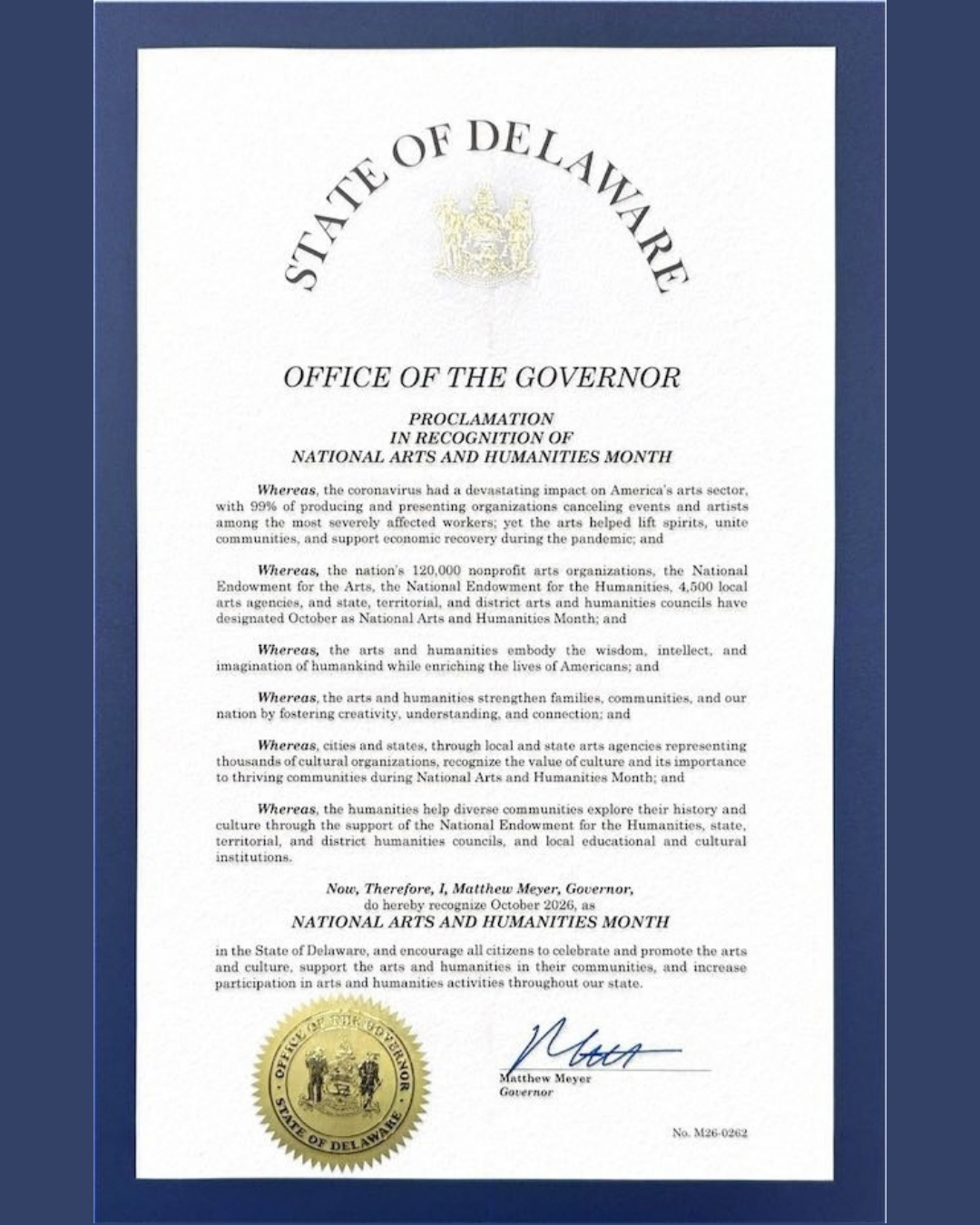
On October 1, Delaware Humanities kicked off National Arts and Humanities Month by sharing a proclamation from Governor Matt Meyer recognizing the importance of our state’s arts and humanities organizations in our Delaware communities. To close the month, I set out to reflect on the contributions that the arts and humanities make, collectively, to our quality of life in Delaware, as well as how they help us navigate the complex world around us.
I turned to the document I have referenced most during my eight years at Delaware Humanities: the National Foundation on the Arts and Humanities Act of 1965. Signed into law by President Lyndon B. Johnson on September 29th, 1965, this legislation created the National Endowment for the Arts and National Endowment for the Humanities. Eventually, this led to a state-level commitment with the Delaware State Arts Council in 1969, and the creation of the nonprofit Delaware Humanities Council in 1973.
Sixty years later, the ideas and conclusions presented there, formed from months of research, continue to resonate and apply to our lives as Delawareans.
- The arts and the humanities belong to all the people of the United States…
- An advanced civilization must not limit its efforts to science and technology alone, but must give full value and support to the other great branches of scholarly and cultural activity in order to achieve a better understanding of the past, a better analysis of the present, and a better view of the future…
- Democracy demands wisdom and vision in its citizens. It must therefore foster and support a form of education, and access to the arts and the humanities, designed to make people of all backgrounds and wherever located masters of their technology and not its unthinking servants…
- The arts and the humanities reflect the high place accorded by the American people to the nation’s rich cultural heritage and to the fostering of mutual respect for the diverse beliefs and values of all persons and groups.…
- The world leadership which has come to the United States cannot rest solely upon superior power, wealth, and technology, but must be solidly founded upon worldwide respect and admiration for the Nation’s high qualities as a leader in the realm of ideas and of the spirit…
- Americans should receive in school, background and preparation in the arts and humanities to enable them to recognize and appreciate the aesthetic dimensions of our lives, the diversity of excellence that comprises our cultural heritage, and artistic and scholarly expression…
- It is vital to democracy to honor and preserve its multicultural artistic heritage as well as support new ideas.
Read the full National Foundation on the Arts and Humanities Act of 1965 on neh.gov, here.

The arts and humanities are available and should be accessible to all of us, individually and collectively. They help us understand and interpret the world around us and imagine what was or dream about what could be. They call on us to think and feel and share those thoughts and feelings with others to make our human experiences richer and our lives together more meaningful. The arts and humanities train and cultivate our superpower: being human.
In a world that is quickly changing, and where our “humanness” might seem to be undervalued in the quest for faster, bigger, cheaper, and more, the arts and humanities might just be what saves us.
Each year, Delaware Humanities recognizes National Arts & Humanities Month with an annual celebration in October. To learn more about this special event, discover ways you can participate, and/or subscribe to our email newsletter, visit https://dehumanities.org/get-involved/.